Conductive silicones are silicone-based elastomers that conduct heat, electricity, or both heat and electricity. These compounds contain special fillers and are available as ready-to-fabricate materials or ready-to-install products. Unlike standard silicones, which are naturally insulating, conductive silicones can carry heat and/or electricity. Applications include aerospace, defense, electronics, electrical vehicles (EVs), and battery energy storage systems (BESS) – just to name a few.
Conductive Silicones: Key Differences
Electrically conductive silicones and thermally conductive silicones both enhance energy transfers; however, their roles, properties, and applications differ significantly.
|
Electrically Conductive Silicones |
Thermally Conductive Silicones |
|
|
Function |
Conduct electricity |
Conduct heat |
|
Fillers |
Silver, aluminum, copper, nickel, graphite |
Aluminum oxide, boron nitride, aluminum nitride, graphite |
|
Electrical Properties |
Electrically conductive with a range of resistivities |
Typically insulating |
|
Thermal Properties |
Moderate thermal conductivity (secondary property) |
High thermal conductivity (primary property) |
|
Applications |
EMI shielding, ESD protection, flexible circuits |
Thermal interface materials, heat dissipation in electronics and LEDs |
Electrically Conductive Silicones
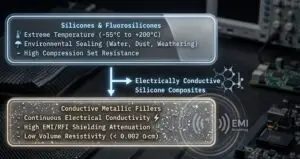
Electrically conductive silicones are specialty elastomers that allow the flow of electrical current. They are formulated by incorporating electrically conductive fillers into the matrix of a silicone elastomer base. This matrix, or network, allows electrons to travel through the compound. The filler materials are metal, bimetallic or metal-coated because metals are generally good conductors of electricity. Silver-coated and nickel-graphite particles are used commonly.
Key Properties
Electrically conductive silicones are available with a range of conductivities, depending on the filer type and concentration. Importantly, these materials retain their electrical properties under environmental conditions that include high temperatures, exposure to water and sunlight, and chemical contact. Compared to other elastomers, silicones also withstand a broader range of temperatures and maintain their properties (thermal stability).
Sealing and Shielding
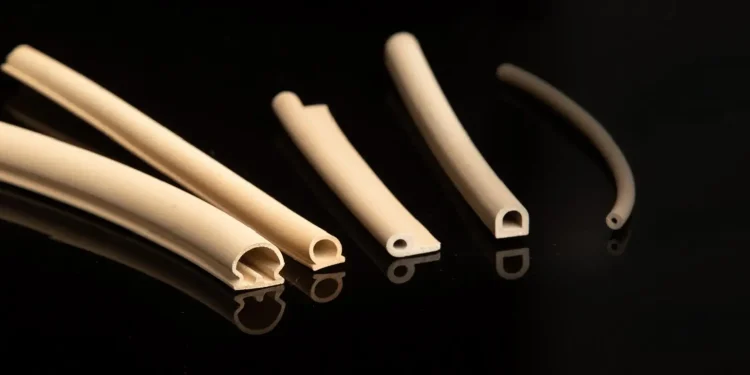
The flexibility of the silicone matrix allows electrically conductive silicones to serve as seals, gaskets, and O-rings. In an electronic enclosure, for example, the metal sides and covers conduct electricity. There are tiny air gaps between mating surfaces, however, and air is not a good conductor of electricity. These gaps also permit the ingress of environmental contaminants and EMI/RFI. Seals, gaskets, and O-rings that are made of EMI/RFI elastomers can seal out the environment and interference.
Where to Find Electrically Conductive Silicones
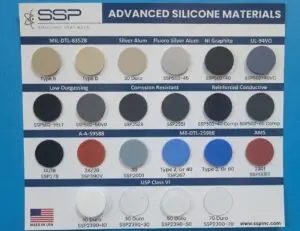
Specialty Silicone Products of Ballston Spa, New York (USA) makes electrically conductive silicones for shielding against electromagnetic interference (EMI) and radio frequency interference (RFI). SSP also fabricates EMI/RFI gaskets and EMI/RFI O-rings from the materials we make at our ISO 9001:2015 certified facility. As a vertically integrated manufacturer, SSP also has its own toolroom and in-house laboratory. Contact us to discuss your application.
Thermally Conductive Silicones
Thermally conductive silicones are specialty elastomers that allow the transfer of heat. They are formulated by incorporating thermally conductive fillers into the matrix of a silicone elastomer base. This matrix, or network, allows heat to travel through the compound. Depending on the specific filler material, thermally conductive silicones may also be electrically conductive. Common fillers include aluminum oxide, boron nitride, aluminum nitride, and graphite or carbon-based fillers.