EMI connector gasket | mil-dtl-83528 type | mil-dtl-83528 gaskets | military connectors | MIL-DTL-83528 emi gasket materials | emi connector gasket | military gaskets

EMI Connector Gaskets

SSP makes EMI connector gaskets for electrical and electronic connectors used in harsh environments and demanding applications.

We make standard and custom products from the EMI silicones we manufacture in Ballston Spa, New York (USA). Many of our materials are MIL-DTL-83528 QPL certified.

SSP makes connector gaskets in M83528/004 slash sizes. We also offer EMI gaskets for other types of connectors used in defense, aerospace, medical devices, robotics, and unmanned systems.

Compare us to Parker Chomerics CHO-SEAL and Nolato Jabar. SSP offers low minimums and quick turnaround times, and we sell to you directly.

What are EMI Connector Gaskets?

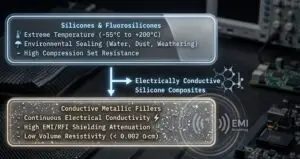
EMI connector gaskets provide environmental sealing and shielding against electromagnetic interference (EMI). They reduce or eliminate the transmission of EMI between connected devices, or through the connector itself.  Connector gaskets are cut or molded from elastomers and fill small gaps between uneven connector surfaces. SSP’s EMI shielding silicones are soft enough to support compression and provide proven levels of shielding while resisting water, moisture, many chemicals, and a wide range of temperatures.

M83528 slash sizes | EMI Connector Gaskets | military connector gaskets
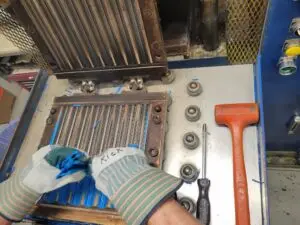
An EMI connector gasket

EMI Connector Gasket Types 

SSP makes EMI connector gaskets for military and civilian applications. Contact us and let us know what you need.

M83528/004 Connector Gaskets

SSP makes M83528/004 military connector gaskets from EMI/RFI shielding silicones that are part of the M83528 Qualified Products Lists (QPL) from the U.S. Defense Logistics Agency (DLA). SSP’s Type A, B, C, D, and K elastomers provide offsets to Parker Chomerics CHO-SEAL and Nolato Jabar products. Whether your volumes are large or small, we offer a choice of fabrication methods.

Circular Connector Gaskets

Circular connector gaskets are designed for rugged circular connectors that resist shock vibration, and contaminants. They typically contain a locking mechanism and are used for power, signal, and data transmission in harsh environments.

D-Sub Connector Gaskets (D-Subminiature)

D-sub connector gaskets are used with D-subminiature (D-sub) connectors, components for reliable data, signal, and power transmission in computers, industrial control and communication. AMPLIMITE from TE Connectivity is a common brand name for these connectors.

Micro-D Connector Gaskets

Micro-D connector gaskets are used with Micro-D connectors and provide sealing and shielding in harsh, space-constrained environments. Micro-D connector manufacturers include NICOMATIC, Omnetics, and AvioRace. Defense and aerospace applications include avionics, missiles, and unmanned aerial vehicles (UAVs)

MDM Connector Gaskets

MDM connector gaskets are used with a specific, high-performance line of Micro-D connectors for defense and aerospace applications and may meet MIL-DTL-83513 requirements. MDM connectors are similar to and sometimes interchangeable with Micro-D connectors; however, these components are not the same. MDM connector manufacturers include Glenair and ITT Cannon. 

Nano-D Connector Gaskets

Nano-D connector gaskets are used with Nano D connectors, which feature an ultra-small, D-shaped design. These connectors are used in military, aerospace, satellite, medical, and robotics applications where size, weight, and power (SWaP) are critical. They are significantly smaller than Micro-D and standard D-sub connectors and may meet MIL-DTL-32139 standards. Omnetics is a leading Nano-D connector manufacturer. 

BNC Connector Gaskets

BNC connector gaskets are used with BNC connectors and feature a secure, twist-to-lock mechanism. They are used in RF applications such as computer networking and video transmissions, and in industrial test equipment like oscilloscopes. Their bayonet locking mechanism ensures a vibration-resistant connection that snaps into place quickly and is also easy to disconnect. 

NASA Spec Connector Gaskets

NASA spec connectors, also known as space-grade connectors, are designed and qualified to meet the requirements of space applications on spacecraft and satellites. They are built to withstand harsh conditions like extreme temperatures, shock, and vibration, and must pass stringent tests for properties like outgassing and residual magnetism, which could interfere with other equipment. 

MIL-C-38999 Connector Gaskets (MIL-DTL-38999)

MIL-C-38999 connector gaskets are miniature, circular connectors for reliable connections in harsh environments with extreme temperatures, vibration, moisture, and corrosion. They are used with MIL-C-38999 connectors, which are now known as MIL-DTL-38999 connectors. MIL-DTL-38999 connector gaskets feature secure coupling mechanisms and are used with aircraft, ships, tanks, and satellites.

MIL-C-26482 Connector Gaskets

MIL-C-26482 connector gaskets are specialized components for miniature, circular, bayonet-style military connectors. Applications for MIL-C-26482 connectors include military vehicles, ground support equipment, aircraft, radar systems, and vacuum chambers. Some connector designs feature integrated grommets for wire sealing.

MIL-C-5015 Connector Gaskets (MIL-DTL-5015, SAE-AS50151)

MIL-C-5015 connector gaskets are heavy-duty, circular connectors that are used in military, aerospace, industrial, rail, robotics, and heavy equipment applications. MIL-C-5015 has been superseded by MIL-DTL-5015 and derivatives such as SAE-AS50151; however, many modern connectors are designed to mate with older MIL-C-5015 connectors.  

MIL-C-83723 Connector Gaskets (MIL-DTL-83723)

MIL-C-83723 connector gaskets meet the requirements of a U.S. military specification (now MIL-DTL-83723) for environmentally sealed circular electrical connectors that feature bayonet or threaded couplings. Applications include aircraft, ground vehicles, and telecommunications. Like the connects that house them, MIL-C-83723 connector gaskets withstand harsh conditions. 

ARINC Connector Gaskets

ARINC connector gaskets are used with connectors such as ARINC 600, a standard for avionics rack and panel connectors. They resist vibration and extreme temperatures, and feature environmental or hermetic sealing for protection against moisture, jet fuel, or other fluids. ARINC connector manufacturers include Amphenol, TE Connectivity, and PEI-Genesis.

LEMO Connector Gaskets

LEMO connector gaskets are designed for LEMO connectors, a type of high-quality connector that’s known for its push-pull latching system. Due to their ruggedness, these connectors are used with industrial automation, aerospace, scientific research, and medical applications, including imaging, monitoring, and surgical equipment. 

MTC Connector Gaskets

MTC connector gaskets are modular, miniature rectangular connectors that are designed for environmentally sealed applications. These electrical connectors prevent moisture, dust, and other contaminants from entering the connector system where it joins a cable or housing. Connector manufacturers include TE Connectivity and Amphenol.

EMI Connector Gasket Types and Compatibility

EMI/RFI connector gaskets are available in multiple geometries and standards to match military, aerospace, and industrial connectors.

M83528/004 Connector Gaskets

Circular Connector Gaskets

  • MIL‑DTL‑38999 Series I, II, III
  • MIL‑DTL‑5015
  • MIL‑DTL‑26482
  • MIL‑DTL‑83723
  • Custom circular profiles for non‑standard housings

Rectangular & D‑Sub Gaskets

  • Standard D‑Sub (9, 15, 25, 37, 50‑pin)
  • High‑density D‑Sub
  • Micro‑D and Nano‑D
  • ARINC 404 / ARINC 600

Compression‑Stop Gaskets

  • Integrated metal or molded‑in compression stops
  • Prevent over‑compression in high‑torque assemblies
  • Maintain long‑term shielding and environmental sealing

Vented vs. Non‑Vented Gaskets

  • Vented: Allows pressure equalization in altitude‑sensitive systems
  • Non‑vented: Maximum environmental sealing

Material Options and Performance Comparison Table

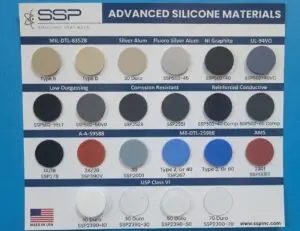
SSP makes  the materials shown in the table below. Contact us to discuss your application. SSP can help you to select the best material for an EMI connector gasket, and we can help you compare a conductive silicone vs. fluorosilicone EMI gasket for your application.

Material

Shielding Effectiveness

Durometer

Fuel/Oil Resistance

Temp Range

Meets MIL-DTL-83528

Conductive Silicone (Silver‑Aluminum)

90–120 dB

65–75

Moderate

–55 to +160°C

Yes

Conductive Fluorosilicone (Silver‑Aluminum)

90–120 dB

70–80

Excellent

–55 to +200°C

Yes

Nickel‑Graphite Silicone

80–100 dB

65–75

Good

–55 to +160°C

Yes

Silver‑Copper Silicone

100–120 dB

65–75

Moderate

–55 to +160°C

Yes

Silver‑Nickel Silicone

110–130 dB

65–75

Good

–55 to +160°C

Yes

How EMI Connector Gaskets Work

EMI/RFI connector gaskets provide both electromagnetic shielding and environmental sealing at the interface between a connector and its mounting surface.

Shielding Mechanism

  • Conductive elastomers create a continuous conductive path between the connector shell and the enclosure.
  • This forms a Faraday cage, preventing electromagnetic energy from entering or escaping the system.
  • Proper compression ensures low contact resistance and stable shielding performance.

Environmental Sealing

  • Silicone and fluorosilicone bases provide:
    • Moisture sealing
    • Dust and particulate protection
    • Chemical and fuel resistance
    • Long‑term compression set resistance

Why Compression Matters

  • EMI gaskets require uniform compression to maintain conductivity.
  • Over‑compression can damage the gasket; under‑compression reduces shielding effectiveness.
  • Compression‑stop designs eliminate torque‑related failures.

Galvanic Compatibility Guide

Galvanic corrosion can degrade shielding performance and shorten gasket life. Material selection should match the connector shell and enclosure metals. SSP makes corrosion resistant EMI gasket materials, and we fabricate these materials into connector gaskets.

Recommended Pairings

Housing Material

Recommended Gasket Material

Notes

Aluminum (Alodine/Anodized)

Silver-Aluminum Silicone

Best match for similar galvanic potential

Stainless Steel

Silver‑Nickel Silicone

Prevents dissimilar metal corrosion

Magnesium Alloys

Nickel‑Graphite Silicone

Reduces galvanic mismatch

Titanium

Nickel‑Graphite or Silver‑Nickel

Stable in aerospace environments

Composite Enclosures

Any conductive elastomer

No galvanic interaction

Failure Modes to Avoid

  • Pitting corrosion
  • Increased contact resistance
  • Loss of shielding effectiveness
  • Mechanical degradation at the interface

Dimensional Guidance and Part Drawings

Typical Connector Gasket Dimensions

Most EMI connector gaskets follow:

  • Standard circular connector OD/ID profiles
  • Bolt‑pattern alignment for MIL‑spec connectors
  • Thicknesses from 0.020″ to 0.125″

Note: Custom thicknesses available for non‑standard compression requirements

Send SSP your drawings so we can provide you with a connector gasket quote.

How to Select the Right Connector Gasket

  • Connector Type: Match the MIL‑SPEC series or commercial connector geometry.
  • Shielding Requirements: Determine the required attenuation (typically 80–120 dB). Higher frequencies may require silver‑nickel or silver‑copper.
  • Environmental Exposure:
    • Fuel/oil exposure needs Fluorosilicone.
    • Salt fog / marine environments need Silver‑Nickel.
    • General electronics needs Nickel‑Graphite or Silver‑Aluminum
  • Compression Requirements: Consider torque limits and need for compression stops.
  • Galvanic Compatibility: Match gasket filler to housing metal to prevent corrosion.

Manufacturing and Customization Capabilities

SSP provides full in‑house manufacturing for EMI/RFI connector gaskets:

  • Precision molding for circular and rectangular profiles
  • Custom geometries for non‑standard connectors
  • Rapid prototyping for development programs
  • In‑house material compounding (conductive silicone & fluorosilicone)
  • Shielding effectiveness testing
  • Compression set and environmental testing
  • Short‑run and high‑volume production

Contact SSP for a quote.

EMI Connector Gaskets FAQ

This section contains answers to frequently asked questions (FAQs) about EMI connector gaskets.

What materials are used for EMI connector gaskets?

Conductive silicone, conductive fluorosilicone, nickel‑graphite silicone, silver‑aluminum silicone, and silver‑nickel silicone are the most common materials.

Do EMI gaskets also provide environmental sealing?

Yes. Conductive elastomers provide both EMI shielding and IP‑rated environmental sealing when properly compressed.

What MIL specifications apply to EMI connector gaskets?

Most conductive elastomers are designed to meet MIL‑DTL‑83528 shielding requirements.

Can EMI connector gaskets be used in aerospace and defense applications?

Yes. Conductive fluorosilicone and silver‑nickel materials are widely used in aerospace, defense, and high‑reliability electronics.

How long do conductive elastomer gaskets last?

Service life depends on environment, but high‑quality silicones typically provide 10–20+ years of performance.

What is typical shielding effectiveness?

Most conductive elastomers provide 80–120 dB of attenuation from 20 MHz to 10 GHz.

Can SSP produce custom connector gaskets?

Yes. SSP manufactures custom shapes, sizes, and materials for unique connector interfaces.

How do I ensure galvanic compatibility?

Match the gasket filler metal to the enclosure metal. Silver‑aluminum pairs well with aluminum; silver‑nickel pairs well with stainless steel.

What is a compression‑stop gasket?

A gasket with an integrated stop feature that prevents over‑compression during assembly.