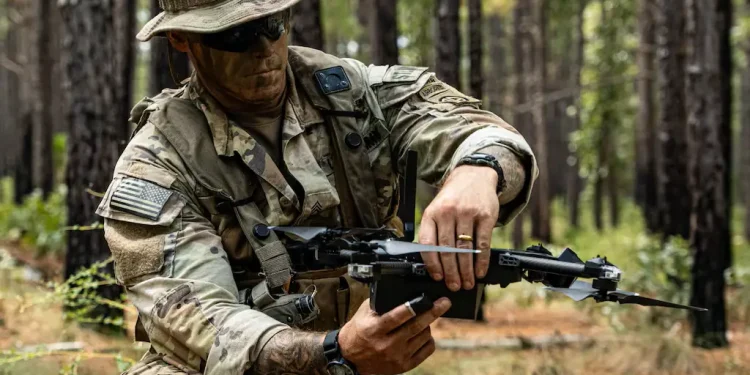
The U.S. military is planning to acquire 300,000 small attack drones and rapidly deploy them to service members. Last month, the Pentagon called upon industry to provide small unmanned aerial vehicles (UAVs) that can carry a minimum of 4.4 lbs. in explosives and conduct strikes across both open terrain and urban environments. The goal is to equip troops with tens of thousands of one-way drones by the end of 2026 and hundreds of thousands of these systems by 2027.
As drone developers reviewed the War Department’s Request for Information (RFI), the U.S. Marine Corps launched six new drone training programs. Although the RFI doesn’t specify an exact UAV model, Marines and other service members are expected to use first-person view (FPV) drones, which provide a live video feed from an onboard camera. FPV drones are typically built as quadcopters and include a battery, antenna, video transmitter, propellers, motors, and controllers.
Drones and Electronic Warfare
Drones can be remotely controlled by a human pilot or autonomously controlled by onboard computers. Either way, they depend upon electronics that are susceptible to interference from onboard sources such as motors and nearby circuits. Drones are also the target of electronic warfare (EW) in the form of jamming, spoofing, and direct electronic attacks that aim to disrupt radio frequency (RF) or Global Navigation Satellite Signals (GNSS).
To answer the Pentagon’s call, drone manufacturers must field products with specific levels of shielding against electromagnetic interference (EMI) and radio frequency interference (RFI). In addition to protection at the printed circuit board (PCB) level, drones need enclosure-level shielding along with environmental sealing. Specialty Silicone Products (SSP) makes shielding silicones that meet these requirements, and we also fabricate EMI/RFI gaskets and O-rings.
EMI Shielding Silicones for Drones
SSP’s shielding silicones include elastomers in the M83528 Qualified Products List (QPL) from the Defense Logistics Agency. These Type A, B, C, D and K materials meet the lettered requirements of MIL-DTL-83528, a U.S. military specification that’s sometimes referred to as MIL-G-83528. SSP’s M83528 QPL Certified shielding silicones are available with low minimums and fast turnarounds, and they can be used instead of Parker Chomerics CHO-SEAL® and Nolato Jabar EMI shielding.
For drone applications that don’t require M83528 QPL Certified materials, SSP offers EMI shielding silicones with non-silver fills. As silver prices continue to climb, products like SSP’s 502 series of nickel-graphite silicones can help to reduce project costs. SSP’s materials are available as sheets, continuous rolls, extrusions, and ready-to-mold compounds. In addition to ready-to-fabricate materials, SSP supplies ready-to-install EMI/RFI gaskets and EMI/RFI O-rings.
EMI Gaskets and EMI O-Rings for Drones
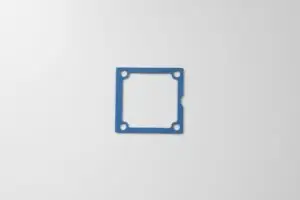
Standard EMI gaskets are available in M83528 slash sizes, but SSP can also cut or mold custom products. At our Made in USA manufacturing facility, we have our own in-house toolroom and use flash cutting, die cutting, and compression molding, depending on your production quantities and project requirements. SSP can apply an electrically conductive pressure-sensitive adhesive (PSA) to your EMI gaskets or EMI gasket sheets, rolls, and extrusions.
SSP also offers standard and custom EMI O-rings that are designed to fit a groove and are crushed in place during installation. Drone applications include EMI shielding and environmental sealing for cameras, batteries, antennas, and transmitters. Among its advantages, silicone resists moisture, water, sunlight, and ozone, all of which are common in outdoor environments. Silicones also resist a wide range of temperatures and maintain their material properties.
Answering the Pentagon’s Call
During the initial phase of its drone sourcing effort, the War Department is seeking 12 companies to produce 30,000 drones. Subsequent phases will produce many more drones as the price per unit and number of vendors decreases. Drone designers and manufacturers, defense contractors, and gasket fabricators are invited to contact SSP for more information about our EMI shielding solutions. SSP is ISO 9001:2015 certified and ITAR registered.