When designing electronics for demanding aerospace, military, medical, and industrial environments, standard elastomeric seals fall short. High-reliability electronics demand a single material that delivers dual performance: continuous environmental sealing against moisture, dust, and extreme temperature fluctuations, along with high-attenuation shielding against Electromagnetic Interference (EMI) and Radio Frequency Interference (RFI).
Electrically conductive silicones bridge this gap by integrating conductive conductive metal or carbon particles directly into a resilient silicone or fluorosilicone polymer matrix. These elastomers are also called EMI shielding silicones, materials that Specialty Silicone Products (SSP) makes at our Made in USA manufacturing facility in Ballston Spa, New York. SSP also makes EMI gaskets.
What Are Electrically Conductive Silicones?
An electrically conductive silicone is a highly engineered composite material that combines the mechanical flexibility, environmental resilience, and thermal stability of synthetic silicone rubber with the electrical conductivity of specialized filler particles.
While unfilled silicone rubber is a natural dielectric insulator, dispersing microscopic conductive particles—such as silver-plated aluminum, nickel-graphite, or carbon black—throughout the polymer matrix creates a three-dimensional conductive network. When an electrically conductive silicone seal is compressed between two mating metallic surfaces, these embedded particles make contact, forming a continuous electrical path that reflects and absorbs electromagnetic radiation while maintaining a tight fluid seal.
Types of Conductive Silicone Fillers & Comparison
The overall electrical conductivity, shielding effectiveness, mechanical durability, weight, and material cost of an electrically conductive silicone are primarily determined by the filler material selected.
| Filler Type | Primary Applications | Shielding Effectiveness | Volume Resistivity (Ω⋅cm) | Temp Range | Relative Cost |
| Nickel-Graphite (Ni/C) | Commercial & Military EMI Gaskets, High Galvanic Corrosion Resistance | 80 – 100 dB | < 0.010 | -55°C to +160°C | Moderate |
| Silver-Plated Aluminum (Ag/Al) | MIL-DTL-83528 Aerospace & Avionics Electronics | > 100 dB | < 0.008 | -55°C to +160°C | High |
| Silver-Plated Copper (Ag/Cu) | High-Attenuation EMP / High-Frequency EMI Seals | > 110 dB | < 0.002 | -55°C to +125°C | High |
| Silver-Plated Glass (Ag/G) | Lightweight Commercial Enclosures, Connector Gaskets | 70 – 90 dB | < 0.010 | -55°C to +160°C | Moderate |
| Carbon Black / Graphite | Electrostatic Discharge (ESD) Protection, Anti-Static Seals | 20 – 40 dB | 1 – 100 | -55°C to +200°C | Economical |
Essential Mechanical & Electrical Properties
Selecting the right electrically conductive silicone elastomer requires balancing electrical performance parameters against physical mechanical constraints:
1. Volume Resistivity (Ω · cm)
Volume resistivity measures the material’s bulk resistance to electrical current.
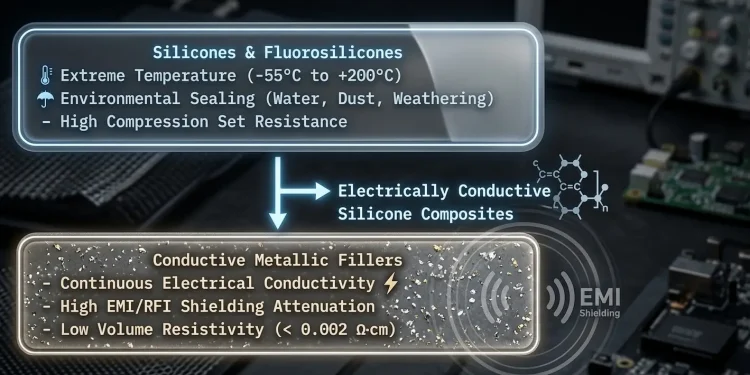
Lower volume resistivity correlates directly to higher electrical conductivity. High-performance military-grade conductive silicones achieve volume resistivity levels lower than 0.002 ohms per centimeter (Ω · cm).
2. Shielding Effectiveness (dB)
Shielding effectiveness quantifies an electrically conductive silicone’s ability to attenuate incoming or outgoing electromagnetic fields across frequency bands ranging from 10 MHz to 10 GHz (tested per ASTM D4935 or MIL-DTL-83528 standards).
3. Durometer (Hardness Shore A)
Conductive silicones are available in formulations ranging from soft (30 Shore A) to firm (80 Shore A). Lower durometer formulations ensure low compression force, making them ideal for delicate enclosures, thin metal housings, or plastic enclosures with co-molded metallic tracks.
4. Base Polymer: Silicone vs. Fluorosilicone
Standard Silicone Base: Maintains flexibility, physical integrity, and conductivity across operating temperatures from -55°C to +200 °C. Excellent for general indoor, outdoor, and weather-exposed applications.
Fluorosilicone (FVMQ) Base: Retains the high conductivity and temperature tolerance of standard silicone while adding chemical resistance to aggressive fluids, solvents, jet fuels (such as JP-8), Skydrol, and oils.
Electrically Conductive Silicone Form Factors
Electrically conductive silicone products are engineered into various stock and custom form factors to meet specific manufacturing and assembly workflows:
Electrically Conductive Silicone Sheets: Uncured or fully cured sheet stock available in standard or custom thicknesses for die-cutting into custom flange gaskets.
Extruded Profiles & Tubing: Continuous extruded solid cords, hollow D-strips, tubular profiles, and channel gaskets designed for enclosure grooves.
Molded O-Rings & Waveguide Gaskets: Precision molded rings and connector gaskets conforming to MIL-DTL-83528 slash sheet specs.
Conductive Compounds: Custom formulation materials ready for compression molding or transfer molding processes.
Key Industry Applications
Aerospace & Defense: MIL-DTL-83528 qualified seals, avionics enclosures, radar units, waveguide interfaces, and military connector gaskets.
Automotive & Electric Vehicles (EV): Battery Management System (BMS) shielding, ECU enclosures, autonomous sensor shielding, and high-voltage inverter seals.
Medical Electronics: Wearable diagnostic devices, shielded medical imaging enclosures, and low-outgassing sterile seals.
Telecommunications: 5G outdoor base station enclosures, antenna feeds, and high-frequency circuit shielding housings.
Frequently Asked Questions (FAQ)
What is the main difference between conductive silicone and conductive fluorosilicone?
Standard conductive silicone provides excellent thermal stability and UV resistance, making it suitable for general EMI shielding. Conductive fluorosilicone offers identical electrical shielding performance but includes specialized fluorocarbon side chains that prevent material degradation and swelling when exposed to jet fuels, solvents, and hydraulic fluids.
How do I prevent galvanic corrosion when using conductive silicone gaskets?
Galvanic corrosion occurs when dissimilar metals come into contact in the presence of an electrolyte (such as salt fog or moisture). To prevent galvanic action against aluminum housings, specify nickel-graphite (Ni/C) or silver-plated aluminum (Ag/Al) conductive fillers, which closely match the electrochemical potential of aluminum alloys.
Can electrically conductive silicone rubber be die-cut or waterjet-cut?
Yes. Electrically conductive silicone sheet material is routinely die-cut or precision waterjet-cut into complex gasket geometries with tight dimensional tolerances.