Specialty Silicone Products (SSP) makes aerospace and military silicones that meet these specifications.
Our Made in USA materials are available with low minimum order quantities and fast turnaround times.
SSP is a vertically integrated manufacturer that makes its own materials and tooling. Plus, we offer a full Certificate of Analysis (COA) with every batch.
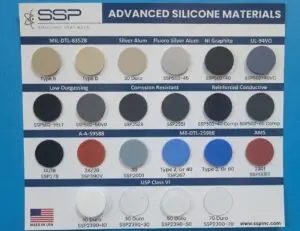
SSP makes military and aerospace silicones and fluorosilicones that are fully tested to and meet the full requirements of AMS, A-A-59588, and MIL-DL-25988 requirements.
We also supply MIL-DTL-83528 silicones and fluorosilicones for EMI shielding, including flame-resistant materials. Our full line of aerospace silicones and military silicones includes space-grade materials for extremely low temperatures and low levels of outgassing.
For traceability, we offer a full Certificate of Analysis (COA) with every batch.
SSP’s AMS grade silicones meet Aerospace Material Specifications (AMS) from SAE International. These elastomers come in a range of durometers and are tested to AMS 3301, 3302, 3345, 3356E, 3325, 3305J, 3303, or 3304 requirements. AMS silicones are used in helicopter bellows, flexible molded sleeves that keep out dust, oil exhaust fumes, and debris. AMS silicone applications also include rotor blade seals, silicone parts that need to withstand exposure to harsh outdoor weather conditions.
Specialty Silicone Products also makes military and aerospace silicones that meet specific requirements within AA59588, a U.S. General Service Administration (GSA) specification that contains six alphanumeric classes with durometer-based grades. Whether you need Class 1A or Class 1B elastomers for low temperatures, Class 2A or 2B materials for high temperatures and many other favorable properties of high-strength silicone, or 3A and 3B silicones for flex fatigue resistance, SSP has what you need. This includes three 3B certified silicones in 50, 60, and 70 durometer.
SSP’s MIL-DTL-25988 fluorosilicones are used in fuel seals and fuel tank seals because these elastomers resist petroleum-based products over a wide temperature range, including temperatures as low as -100° C. Product offerings include Type 1 and Type 2 materials that meet Class 1 and Class 2 requirements in various durometer-based grades. Like AMS and AA59588 silicones, the most popular colors for SSP’s MIL-DTL-25988 fluorosilicones are red, blue, and black.
SSP’s MIL-DTL-83528 QPL certified EMI shielding silicones meet the requirements of MIL-DTL-83528, a U.S. military specification for electrically conductive elastomeric shielding gaskets. They’re also part of the M83528 Qualified Product List (QPL) from the Defense Logistic Agency (DLA). Our MIL-DTL-83528 Type A, B, C, D, and K elastomers provide offsets to Parker Chomerics CHO-SEAL® materials.
In addition, we make space-grade silicones for applications that include military and civilian satellites and ground stations.
Aerospace silicones combine high temperature resistance with flexibility, durability, chemical inertness, and excellent sealing capabilities. SSP’s materials are supplied as ready-to-mold compounds and compression-molded sheets. Applications include reinforced silicone seals for aircraft engines and fan blades and aircraft doors and hatches that require resistance to a wide temperature range.
Aerospace silicones are a broad category of materials, and their applications can be categorized as follows.
Aerospace silicones are high‑performance elastomers engineered to withstand extreme temperatures, vibration, pressure changes, fuels, hydraulic fluids, and environmental exposure common in aircraft and spacecraft systems. They are used for sealing, insulation, gasketing, vibration damping, and EMI shielding.
Silicones maintain flexibility, compression set resistance, and mechanical stability across a broad temperature range, often from –60°C to +260°C. They also resist ozone, UV, thermal cycling, and long‑term aging—making them ideal for mission‑critical aerospace environments.
Common aerospace silicone categories include:
Materials are typically available as sheets, rolls, molded parts, extrusions, O‑rings, die‑cut gaskets, and custom‑fabricated components.
Most aerospace‑grade silicones operate reliably from –60°C to +260°C. Specialized formulations can exceed these limits depending on the application.
Standard silicone offers excellent temperature and environmental resistance, while fluorosilicone adds resistance to fuels, oils, solvents, and hydraulic fluids—making it essential for fuel systems, engine compartments, and fluid‑exposed components.
Yes. Many aerospace silicones meet specifications such as A-A-59588, MIL‑DTL‑25988, and various MIL‑SPEC EMI shielding requirements. These standards define mechanical, thermal, and chemical performance criteria.
Typical applications include aircraft sealing systems, avionics enclosures, fuel system components, environmental control systems, radar and communications equipment, and high‑temperature engine‑adjacent assemblies.
Absolutely. Manufacturers can tailor durometer, color, thickness, conductivity, thermal properties, and part geometry to meet specific aerospace design requirements.
Specialized formulations can meet NASA and ESA low‑outgassing standards, making them suitable for satellites, spacecraft, and vacuum environments where material outgassing can damage optics or electronics.
Here are some additional resources about SSP’s aerospace silicones and military silicones.