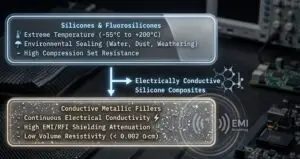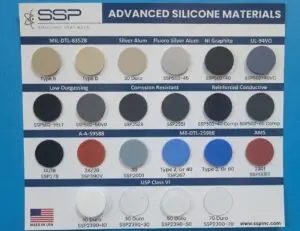
SSP provides electric vehicle EMI shielding (EV EMI shielding) as ready-to-fabricate EMI silicones and ready-to-install EMI gaskets. The materials that we manufacture and the finished products that we fabricate are solid silicones and fluorosilicones that are filled with metal or metal-coated particles.
EV EMI Shielding Reference Table
Use the table below to find SSP materials (i.e., Typical Conductive Elastomer Options) for EV Systems. Then use the links in that column to find available products such as nickel-graphite silicones and silver-aluminum silicones.
EV Subsystem | EMI Gasket Location | Primary EMI Shielding Function | Environmental / Mechanical Requirements | Typical Conductive Elastomer Options |
Battery Pack (BESS) | Pack lid perimeter, service cover, HV junction box, BMS enclosure | Shield BMS from inverter noise; contain switching emissions from HV bus | IP67–IP69K sealing, compression set resistance, thermal cycling, chemical exposure | |
Inverter / Traction Power Electronics | Inverter housing, gate driver module, DC‑link capacitor cover | Suppress SiC/MOSFET switching noise; reduce radiated emissions | High‑temp stability (150–200°C), vibration resistance, oil exposure | Silver‑plated copper silicone, nickel‑graphite silicone, oriented wire‑in‑silicone |
On‑Board Charger (OBC) | OBC enclosure, AC/DC filter housing | Shield high‑frequency switching supplies; prevent conducted/radiated noise | Thermal cycling, humidity, salt fog, IP sealing | |
DC‑DC Converter | Converter housing, control PCB shielding | Reduce noise coupling between HV and LV domains | Thermal stability, mechanical shock, EMI continuity | |
Motor / Drive Unit | Motor controller housing, resolver/encoder interface, HV terminal covers | Shield resolver signals; suppress inverter‑induced EMI | Oil resistance, vibration, high temperature | |
ADAS Sensors (Radar/Lidar/Camera) | Sensor housing, RF window frame, ECU enclosure | Prevent cross‑talk; protect sensitive RF front‑ends | UV resistance, thermal cycling, low compression force | Conductive foam, conductive silicone |
Telematics / Connectivity Modules | TCU housing, antenna module interface | Reduce interference with LTE/5G/WiFi/Bluetooth | Low compression force, stable conductivity | Conductive foam, fabric‑over‑foam |
Infotainment / Displays | Display EMI frame, head unit enclosure | Reduce emissions from processors; protect RF subsystems | Low compression force, ESD protection | Conductive foam, fabric‑over‑foam |
Charging Port (AC/DC Fast Charge) | Charge inlet housing, CCS/CHAdeMO interface | Shield HV switching noise during fast charging | Weather sealing, chemical resistance, thermal cycling | |
HV Cable Shield Terminations | Shielded cable ends, HV junctions | Maintain shielding continuity; reduce radiated emissions | Flexibility, vibration resistance | Conductive elastomers, conductive tapes |
Body Control Modules (BCM) | Module enclosure, connector interfaces | Protect low‑voltage electronics from HV EMI | Low compression force, stable conductivity | Conductive foam, conductive silicone |
HVAC / Heat Pump Electronics | Compressor inverter, control module | Shield switching noise; protect CAN/LIN communication | Moisture resistance, vibration, thermal cycling |
Frequently Asked Questions (FAQs) About SSP’s EMI Shielding for Electric Vehicles
Q: Why Do EVs Need EMI Shielding?
Electric vehicles (EVs) are susceptible to electromagnetic interference (EMI) because they put significant amounts of electrical and electronic content into confined spaces. The radiated and conductive emissions from these systems can disrupt circuits and result in conditions that range from minor inconveniences to dangerous losses of vehicle function.
Without proper EMI shielding, performance and safety can suffer.
Whether you’re designing an EV battery box, an EV charging station, or an enclosure for EV sensors or optics, you’ll like how SSP’s EMI/RFI conductive silicones have shorter lead times and are available in lower minimum order quantities (MOQs). Plus, they’re made in our ISO 9001:2015 certified facility and supplied as sheets, rolls, ready-to-mold compounds, extrusions, and molded or bonded O-rings.
Here are some other things to know about SSP’s solutions for EV sealing and shielding.
Q: Do EV EMI Gaskets Need High-Temperature Protection?
Yes. EV batteries can reach operating temperatures of 45°C (113°F) and, consequently, produce a significant amount of heat. Whether their chemistry is lithium-ion, nickel-metal hydride, or lead-acid, EV batteries are enclosed in metal boxes that typically are made of aluminum. SSP’s EMI/RFI conductive silicones fill the tiny gaps between machined metal surfaces and can resist temperatures as high as 220°C (428°F).
Q: Does SSP Make Flame Retardant EV EMI Shielding?
Yes. Fires caused by EV batteries or EV charging stations can be catastrophic. To prevent thermal runaway, EV designers are using various cooling techniques and experimenting with phase change materials. Once a fire starts, however, however, what matters most is how to contain it. SSP’s EMI/RFI conductive silicones include flame-retardant silicones that conform to UL-94 V0, a widely-used flammability standard.
Q: Do EMI Silicones for EVs Provide Environmental Sealing?
Yes. SSP’s electrically-conductive silicones provide thermal stability over a temperature range from -60°C to 220°C (-51°F to 428°F). These sealing and shielding materials also resist water, ozone, and sunlight, making them a good choice for EV charging stations. Silicones can resist some automotive fluids, and SSP offers EMI/RFI fluorosilicones for applications where broader chemical resistance is required.
Q: Is There Military-Grade RF Shielding for EVs?
Several years ago, members of Congress asked the U.S. Army to start a pilot program that examines how tactical electric vehicles would operate in the field. Previously, the Army set itself a goal of fielding hybrid electric tactical vehicles by 2025. SSP’s EMI/RFI conductive silicones are ready for duty and include materials that meet MIL-DTL-83528 requirements for elastomeric gaskets that provide sealing and shielding.
Q: Does SSP Make Large EMI O-Rings in Custom Sizes?
Specialty Silicone Products also serves the EV industry by making large, one-piece EMI O-rings in custom sizes that can fit any battery enclosure. At our Ballston Spa, New York (USA) manufacturing facility, we have the equipment and in-house toolroom that’s needed to expedite your project. SSP also bonds EMI O-rings in a process that reduces the risk of EMI/RFI leakage and eliminates “hard spots”.
Q: What About Low-Outgassing for Optics and Sensors?
When the volatiles in elastomers evaporate they can condense upon something else. With optics and sensor covers, yellowing can occur. That’s why SSP’s EMI/RFI conductive silicones include materials that have been independently tested to ASTM E595 outgassing parameters. Although this standard originated with NASA, SSP’s low-outgassing EMI/RFI silicones can be used on the road as well as in outer space.
Q: Does Electric Vehicle EMI Shielding Protect Sensitive Electronics?
EMI and RFI aren’t just problems for EV batteries and EV charging stations. These electromagnetic disturbances can also interfere with onboard systems such as backup cameras, safety sensors, GPS, and satellite radio. SSP’s conductive elastomers can help protect sensitive EV electronics, but these innovative materials are also helping to protect drivers, passengers, and pedestrians.
Get SSP’s EVEMI Shielding White Paper
In a white paper, Specialty Silicone Products (SSP) explains what engineers need to know about protecting EVs from EMI. SSP, a global provider of conductive elastomers for EMI gaskets, examines the sources of EMI for all types of electric vehicles and explains how, when, where and why to use particle-filled silicones. Moreover, SSP describes cost-effective but high-performing alternatives to silver filled materials.
SSP’s white paper also describes solutions to related challenges. For example, the EMI O-rings in EVs require proper compression, reliable high-temperature resistance, and efficient fabrication. Molded EMI O-rings don’t require bonding, but they cost more and have higher tooling costs and lead times. With the right bonded O-rings, however, the EV industry can control costs and optimize performance.
For engineers who work with EV batteries, flame resistance is also imperative. Engineers want EMI gasket materials that meet UL 94 V-0 flammability requirements, but two trusted materials from W.L. Gore are no longer available. Fortunately, engineers now have new alternatives – and ones that are supported by third-party test data. Battery engineers can also find EMI shielding that resists galvanic corrosion.