When specifying seals, gaskets, and elastomeric components for defense and aerospace applications, standard commercial-grade silicones often fall short. Military platforms operate under severe environmental conditions, combining extreme ambient temperature swings with continuous exposure to jet fuels, hydraulic fluids, and synthetic lubricants.
To ensure material reliability, military callouts on engineering drawings frequently mandate compliance with MIL-DTL-25988 (formerly MIL-R-25988).
Understanding how this specification categorizes fluorosilicone materials—and how to decode its types, classes, and grades—is critical for design engineers, quality assurance managers, and procurement specialists working on defense contracts.
What is MIL-DTL-25988?
MIL-DTL-25988 is the military detail specification governing oil- and fuel-resistant fluorosilicone rubber (FVMQ). It covers sheet stock, extruded profiles, molded parts, and continuous rolls engineered to withstand immersion in petroleum-based fuels and synthetic lubricants while retaining flexibility across a temperature range of -55°C to +175°C (-67°F to +347°F) (with short-term excursions up to +200°C).
Originally designated as MIL-R-25988, the specification was updated under military standardization reforms to MIL-DTL-25988. However, both designations remain widely referenced on legacy and current defense engineering prints.
Decoding MIL-DTL-25988 Classifications
MIL-DTL-25988 organizes materials by product form (Type), mechanical performance requirements (Class), and durometer hardness (Grade).
1. Specification Types (Product Form)
Type I: O-rings and compression seals (molded cross-sections).
Type II: Molded sheet, continuous roll stock, strip, and extruded shapes.
Type III: O-rings with special low-compression set requirements.
Type IV: Molded shapes other than O-rings.
2. Specification Classes (Performance & Tear Strength)
Class 1 (General Purpose): Standard fluorosilicone formulation providing fuel and oil resistance with good physical properties.
Class 2 (High Tear Strength): Engineered for applications requiring higher tear resistance, improved tensile strength, and enhanced durability during installation or dynamic movement.
Class 3 (High Temperature): Formulated specifically for applications requiring prolonged thermal stability at the upper temperature limit.
Class 4 (Low Compression Set): Optimized for continuous static sealing where long-term seal recovery under load is critical.
3. Specification Grades (Durometer Hardness)
Grades designate nominal hardness (Shore A durometer), typically ranging in 10-point increments:
Grade 40: Soft (40 ±5 Shore A) – Ideal for thin-walled enclosures and low closure force seals.
Grade 50: Medium-Soft (50 ±5 Shore A).
Grade 60: Medium (60 ±5 Shore A) – Common general-purpose durometer.
Grade 70: Hard (70 ±5 Shore A) – Higher pressure resistance and extrusion resistance.
Grade 80: Extra Hard (80 ±5 Shore A).
Example Callout Breakdown: MIL-DTL-25988, Type II, Class 1, Grade 60 specifies a 60 durometer fluorosilicone sheet or roll stock designed for general-purpose fuel-resistant sealing.
Key Physical & Qualification Testing Requirements
To achieve compliance with MIL-DTL-25988, high-performance fluorosilicone rubber (FVMQ) must undergo strict qualification and lot-acceptance testing. Key performance benchmarks include:
Fluid Immersion & Volume Swell: Tested by subjecting specimens to standard reference fuels (such as Iso-octane) and synthetic lubricants. Compliant materials demonstrate minimal volume change and retain physical properties after full immersion.
Compression Set under Load: Verifies that gaskets maintain sealing force over time without taking a permanent set.
Low-Temperature Brittleness: Ensures the material will not crack or fail when exposed to sub-zero high-altitude or arctic start-up conditions.
Ozone & Environmental Weathering: Resistance to cracking under UV light, ozone, and atmospheric exposure.
Typical Military & Aerospace Applications
Spec-grade fluorosilicones are specified across sea, air, and land platforms where fluid contact and thermal cycles intersect:
Aviation & Avionics: Fuel system manifold gaskets, wing-tank access panel seals, wiring harness grommets, and engine compartment seals.
Ground Defense Vehicles: Transmission fluid gaskets, fuel line seals, and hatch environmental seals for armored vehicles.
Naval & Marine Electronics: Weather-tight, fuel-resistant enclosure seals exposed to marine environments and deck solvents.
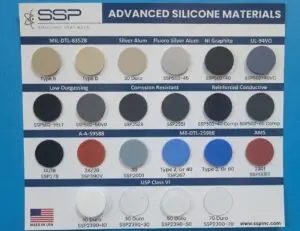
For defense electronics requiring dual protection against fluid intrusion and electromagnetic interference, engineers often specify conductive formulations that align with MIL-SPEC fluorosilicone sheet stock and compounds filled with nickel-graphite or silver-plated aluminum particles.
Sourcing Compliant Fluorosilicone Materials
Procuring materials for military programs requires strict traceability, certificates of analysis (CoA), and consistent batch-to-batch compounding. Using non-compliant commercial silicone in place of certified FVMQ risks severe fluid swell, gasket blowouts, and mission-critical equipment failure.
Whether your engineering drawing calls out legacy MIL-R-25988 or current MIL-DTL-25988 specifications, working with an experienced manufacturer ensures your fuel-resistant fluorosilicone gaskets meet exact durometer, thickness, and qualification standards.
Contact Specialty Silicone Products (SSP) to request material data sheets, obtain certificates of compliance, or discuss custom compounding and conversion for your defense application.