Radio frequency interference (RFI) poses a constant threat to sensitive electronics across aerospace, defense, telecommunications, medical equipment, and automotive systems. Operating across higher frequency bands (10 kHz to 100 GHz), unshielded RF signals disrupt system performance, degrade signal integrity, and risk non-compliance with strict electromagnetic compatibility (EMC) standards.
To protect sensitive components and meet international compliance standards, design engineers rely on RF shielding materials. While traditional metal enclosures offer basic protection, electrically conductive silicones provide the ideal combination of high attenuation RF shielding and environmental sealing against moisture, dust, fuels, and weather.
What Are RF Shielding Materials?
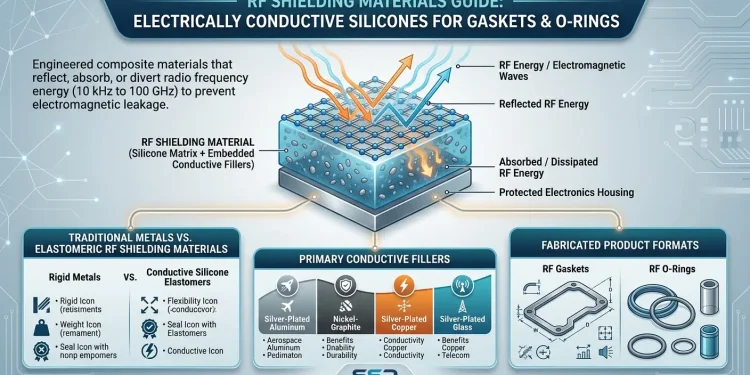
RF shielding materials are specialized composites engineered to reflect, absorb, or divert unwanted radio frequency energy away from sensitive electronics. They function by creating an electrically continuous path across seams, mating joints, and enclosure covers to prevent electromagnetic leakage.
Traditional Metals vs. Elastomeric RF Shielding Materials
Rigid Metals (Aluminum, Copper): Provide solid electrical conductivity but add significant weight, lack flexibility, fail to seal against fluid or gas ingress, and cannot adapt to surface irregularities in mating enclosures.
Conductive Silicone Elastomers: Blend high electrical conductivity with mechanical compliance, making them the preferred RF shielding materials for applications requiring dual environmental sealing and EMI/RFI protection.
Conductive Silicones: The Modern Choice for RF Shielding
Unfilled silicone is a natural electrical insulator. To transform raw silicone rubber into an effective RF shielding material, conductive metallic or carbon filler particles are evenly dispersed throughout the polymer matrix.
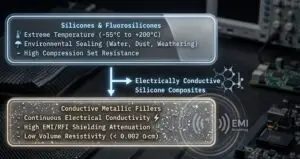
When compressed within a joint, these microscopic filler particles contact one another, establishing a low-resistance path that dissipates RF energy across operating temperatures ranging from -55°C to +200°C.
Primary Conductive Fillers for RF Shielding Materials
Selecting the right filler type ensures optimal shielding effectiveness (dB), volume resistivity ($\Omega\cdot\text{cm}$), and galvanic corrosion resistance:
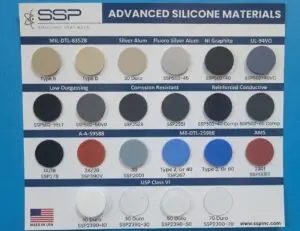
Silver-Plated Aluminum (Ag/Al): The gold standard for military and aerospace RF shielding materials. Qualified under MIL-DTL-83528, it provides >100 dB attenuation with light weight.
Nickel-Graphite (Ni/C): A cost-effective, highly durable RF shielding material offering excellent galvanic corrosion resistance when mated against aluminum enclosure housings.
Silver-Plated Copper (Ag/Cu): Ideal for severe electromagnetic pulse (EMP) applications requiring maximum conductivity and attenuation (>100 dB).
Silver-Plated Glass (Ag/G) Lightweight, medium-cost filler choice for commercial telecommunications and electronics enclosures.
Carbon Black / Graphite: Economical option engineered primarily for Electrostatic Discharge (ESD) protection and anti-static grounding.
Fabricated Product Formats: RF Gaskets & O-Rings
Electrically conductive silicone RF shielding materials are processed into several key form factors to support distinct assembly, enclosure, and sealing configurations: RF gaskets and RF O-rings

1. Die-Cut & Extruded RF Shielding Gaskets
Manufactured from conductive silicone sheet stock or continuous profile extrusions (solid cord, hollow D-strip, rectangular), RF shielding gaskets prevent RF leakage across large cabinet doors, access panels, and flange interfaces.
2. Molded RF Shielding O-Rings
Molded into standard or custom circular cross-sections (including MIL-DTL-83528 slash sizes), RF shielding O-rings provide hermetic environmental sealing and reliable RF grounding in cylindrical enclosures, waveguides, and military cable connectors.
Key Industry Applications
Aerospace & Defense: Avionics enclosures, radar guidance systems, military communications, and MIL-DTL-83528 connector seals.
Telecommunications: 5G base stations, outdoor antenna enclosures, and high-frequency microwave housings.
Automotive & Electric Vehicles: Autonomous driving sensors, Radar/LiDAR housings, and Battery Management Systems (BMS).
Medical Electronics: Shielded diagnostic equipment, wearable biometric devices, and sensitive imaging monitors.
Frequently Asked Questions (FAQ)
What makes conductive silicone better than metal for RF shielding materials?
Metal provides high conductivity but lacks elastomeric resilience. Conductive silicone acts as both an RF shielding material and an environmental seal, conforming to surface irregularities and stopping water, dust, and chemical ingress.
How do I choose the correct RF shielding material for fuel-exposed environments?
For applications exposed to jet fuels, solvents, or hydraulic fluids, specify a fluorosilicone (FVMQ) base polymer rather than standard silicone. Fluorosilicone provides identical RF shielding performance while preventing material degradation and swelling.
What supply formats are available for conductive silicone RF shielding materials?
Specialty Silicone Products (SSP) supplies conductive silicones as cured sheet stock, continuous rolls, extruded profiles, ready-to-mold compounds, and finished die-cut gaskets or O-rings.