When elastomeric seals and gaskets come into contact with aggressive fluids—such as JP-8 jet fuel, Skydrol, or synthetic hydraulic fluids—one of the most common causes of premature failure is gasket swell. Volume swell occurs when fluid molecules diffuse into the polymer matrix of an elastomer, pushing the molecular chains apart.
Left unaddressed, gasket swell leads to severe joint leakage, bolt torque loss, extrusions under line pressure, and complete catastrophic seal degradation.
Understanding the chemical mechanics behind polymer swelling—and selecting the proper elastomer engineered to resist fluid absorption—is essential for maintaining long-term joint integrity in aviation fuel systems, defense platforms, and high-pressure fluid handling lines.
The Physics of Gasket Swell: Why Standard Silicone Fails
Standard silicone rubber (VMQ) features a siloxane backbone ($Si-O$) that delivers broad temperature stability. However, its non-polar polymer structure shares a high chemical affinity with hydrocarbon-based fuels, petroleums, and non-polar solvents.
When exposed to jet fuels, gasoline, or aromatic hydraulic fluids:
Fluid Absorption: Hydrocarbon molecules rapidly penetrate the open polymer network of VMQ.
Volumetric Expansion: The cross-linked polymer matrix expands, causing volumetric swell rates that can exceed 40% to 100% depending on immersion duration and temperature.
Mechanical Degradation: As the seal swells, tensile strength, tear resistance, and Shore A durometer drop drastically. The rubber softens, making it highly susceptible to pinch damage or blowout.
Permanent Compression Set: Upon thermal cycling or fluid evaporation, the degraded seal loses its elastomeric memory, leaving a permanent gap between mating flanges.
The Fluorinated Solution: How Fluorosilicone (FVMQ) Halts Swell
To eliminate fuel-induced volumetric expansion without forfeiting sub-zero thermal flexibility, polymer chemists modify standard silicone by substituting trifluoropropyl side groups onto the polymer backbone.
This yields Fluorosilicone rubber (FVMQ).
The electronegative fluorine atoms create a physical and chemical barrier that actively repels non-polar hydrocarbon fuels, synthetic lubricants, and aggressive solvents.
Standard Silicone (VMQ) + Fluorinated Side Chains = Fluorosilicone (FVMQ)
Result: Fluorine atoms shield the polymer backbone -> Repels fuels & halts swell
By specifying high-performance fluorosilicone rubber (FVMQ), design engineers reduce volume swell in JP-8, Jet A, and aviation gasolines down to single-digit percentages (typically under 5% to 10% depending on durometer and compound grade).
Fluid Compatibility Comparison
Selecting the right material requires evaluating the exact fluid medium operating in your application:
| Fluid Medium | Standard Silicone (VMQ) | Fluorosilicone (FVMQ) | Fluorocarbon (FKM) |
| Aviation Gas / Jet Fuels (JP-4, JP-8) | Severe Swell (Fail) | Excellent Resistance | Excellent Resistance |
| Phosphate Ester Fluids (Skydrol) | Fair / Poor | Good / Grade Dependent | Poor (Avoid) |
| Petroleum Hydraulic Oils | Severe Swell (Fail) | Excellent Resistance | Superior Resistance |
| Sub-Zero Cold Flexibility (-55°C) | Retains Flexibility | Retains Flexibility | Stiffens / Freezes |
While fluorocarbon (FKM) also offers superior resistance to petroleum oils, it stiffens below -20°C. In high-altitude flight or arctic operations, fuel-resistant fluorosilicone gaskets provide the unique combination of sub-zero resilience (-60°C) and tight volumetric swell control.
Best Practices for Preventing Fluid-Induced Gasket Failure
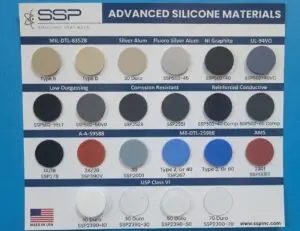
Match Drawing Callouts to Spec-Grade Standards: Ensure aerospace and defense prints specify verified military or industrial standards, such as MIL-SPEC fluorosilicone sheet stock and compounds conforming to MIL-DTL-25988 or AMS 3325.
Account for Flange Load & Durometer: Choose a durometer (typically 50 to 70 Shore A) that provides sufficient seal compression without over-stressing mating enclosure covers or composite flanges.
Verify Operating Thermal Cycles: Ensure the chosen compound accounts for combined thermal and fluid stress across the entire operational envelope.
Protect Your Systems Against Seal Degradation
Gasket swell doesn’t have to compromise your fluid handling systems or defense hardware. Working with precision material formulators ensures your gaskets maintain exact dimensional tolerances, retention force, and fluid barrier performance across demanding service cycles.
Contact Specialty Silicone Products (SSP) to request fluid compatibility data, order sheet samples, or discuss custom fluorosilicone formulations tailored to your application.