
SSP’s EMI Gasket Material Selection White Paper is the resource that you need to understand particle-filled silicones for environmental sealing and EMI shielding.
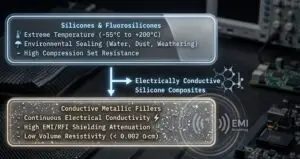
Electronic designers need gaskets that resist electromagnetic interference (EMI), support electrical conductivity, and provide environmental sealing. In the automotive, aerospace, communications, and medical device industries, EMI gaskets made of particle-filled silicones are meeting these challenges. Yet designers also need elastomeric shielding with specific material properties such as softness or resistance to fuels. Cost-effectiveness and ease-of-fabrication are important, too.
How to Choose Particle-Filled Silicones to Meet Multiple Design Requirements
How can electronic designers and gasket fabricators balance all of these requirements? In a new white paper, Specialty Silicone Products (SSP) explains what you need to know. In How to Choose Particle-Filled Silicones to Meet Multiple Design Requirements, SSP covers these and other topics:
Understanding Particle-Filled Silicones
Electrical Conductivity, Material, Properties, and Cost
Nickel-Graphite Silicones
Silver-Aluminum and Other Silver-Filled Silicones
Balancing Sealing and Shielding Requirements
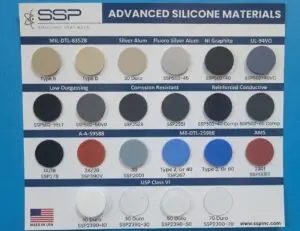
The How to Choose Particle-Filled Silicones white paper also contains tables that describe relationships between various parameters. For example, readers can compare fill types and costs, and see the relationship between fill types and maximum volume resistivity (VR), a commonly-used method for indirectly indicating EMI shielding effectiveness. MIL-DTL-83528, a U.S. military standard that specifies a minimum shielding effectiveness of 100 dB, also provides a framework for comparison.